
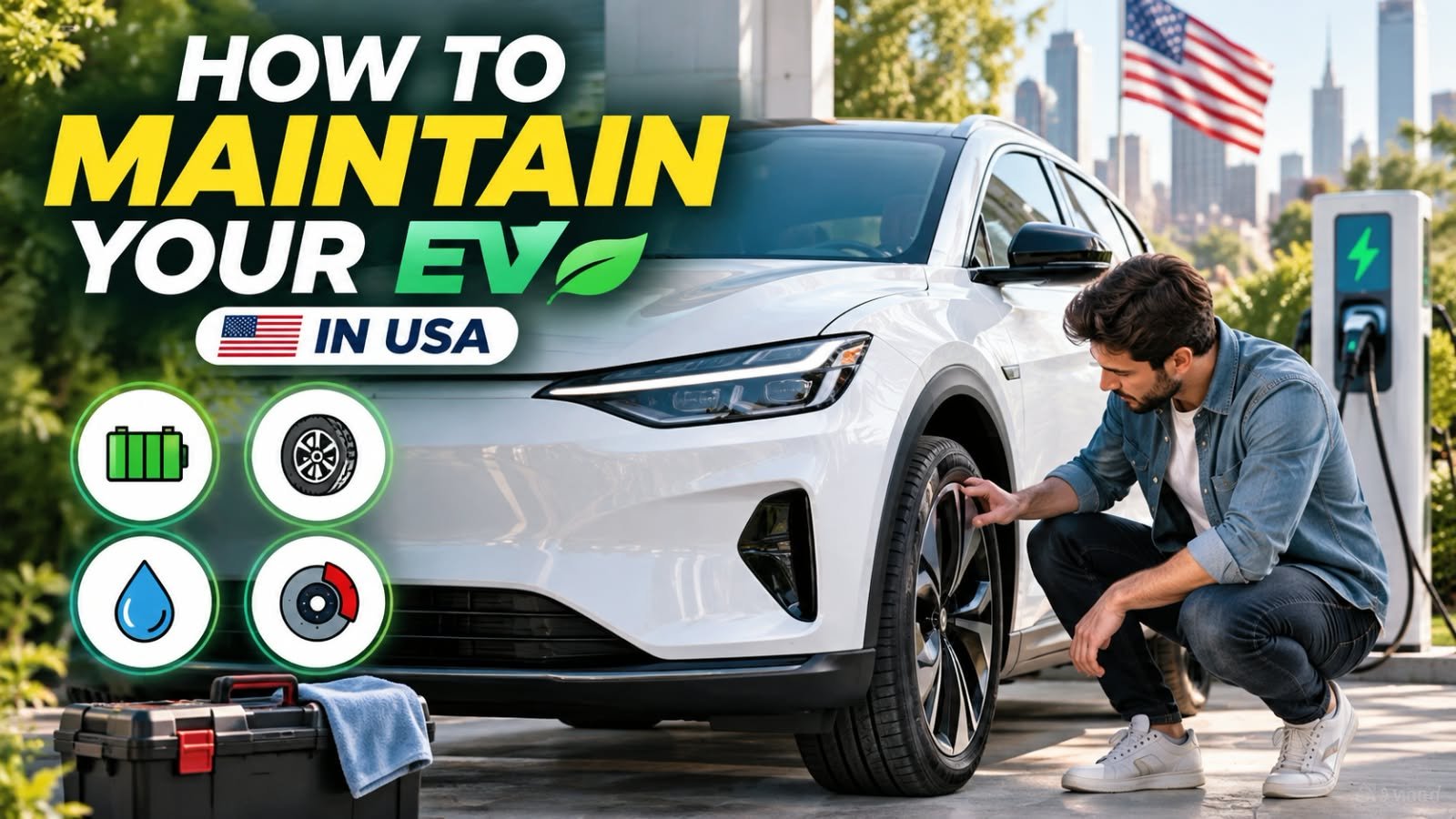
How to Maintain Your EV in the U.S.: A Complete Owner’s Guide
Owning an electric vehicle fundamentally changes what “car maintenance” means. Gone are the days of scheduling oil changes every 5,000 miles, replacing spark plugs, swapping out timing belts, or worrying about transmission fluid — because EVs simply don’t have those parts. A typical gas engine contains hundreds of moving components working together in a complex combustion process; an EV’s electric motor, by contrast, has only a handful of moving parts, which dramatically reduces the number of things that can wear out or fail.
That said, “low maintenance” doesn’t mean “no maintenance.” EVs still rely on tires that wear differently due to the car’s extra weight, brake systems that need periodic inspection even with regenerative braking doing most of the work, cabin air filters that keep your interior air clean, and — most critically — a battery pack that determines your car’s range, performance, and long-term value. How you charge, where you park, and how often you visit a service center all directly affect how well that battery holds up over the years.
This guide walks through every major maintenance area — routine upkeep, battery health, seasonal care, and even the growing role of Chinese-made batteries in U.S. EVs — so you know exactly what your car needs and when.
Here’s everything you need to know to keep your EV running smoothly for years to come.
How to Maintain Your EV : Why EV Maintenance Is Different
A gas-powered car has hundreds of moving parts in its engine alone. An EV’s motor has just a handful. That means no oil changes, no timing belts, and no exhaust system to worry about. But EVs bring their own quirks — they’re heavier (thanks to the battery pack), and that battery needs smart care to last.
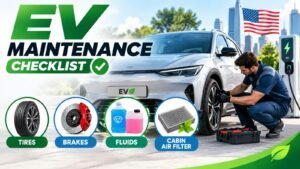
How to Maintain Your EV : – outine Maintenance Checklist
Tires
EVs are typically 10–20% heavier than comparable gas cars because of the battery, which accelerates tire wear. Rotate your tires every 7,500–10,000 miles and check tire pressure monthly — underinflated tires hurt both range and tire lifespan.
Brakes
Most EVs use regenerative braking, which slows the car by feeding energy back into the battery instead of relying solely on brake pads. This means EV brake pads often last far longer than a gas car’s. Still, have a technician inspect them periodically and flush the brake fluid roughly every two years.
Fluids
You won’t be checking engine oil, but you do still have windshield washer fluid and coolant — EVs use coolant loops to manage battery and motor temperature. Check these per your owner’s manual schedule.
Cabin Air Filter
Often overlooked, this filter keeps the air inside your car clean. Swap it every 15,000–30,000 miles, or about once a year.
Protecting Battery Health
The battery is the most expensive component in an EV, so a little discipline goes a long way:
- Avoid charging to 100% routinely (with one notable exception — see below). Keeping your daily charge between roughly 20–80% reduces long-term stress on most battery types. Save the full charge for road trips.
- Limit fast charging. DC fast chargers (Level 3) are convenient but generate more heat, which accelerates battery wear over time. Use Level 2 home/public charging for daily use when you can.
- Mind extreme temperatures. Parking in intense heat or freezing cold for extended periods — especially unplugged — isn’t ideal for battery longevity. If possible, keep your EV plugged in during extreme weather so it can manage its own temperature.
- Know your warranty. Federal law requires automakers to warranty EV batteries for at least 8 years or 100,000 miles, whichever comes first — some manufacturers offer more.
Chinese-Made Batteries: What U.S. Owners Should Know
A growing number of EVs sold in the U.S. — including standard-range Tesla Model 3 and Model Y trims — use battery cells made or licensed by Chinese manufacturers, primarily CATL and BYD. If your EV has one of these packs, a few things work a little differently.
The dominant chemistry: LFP
Chinese battery makers built their global lead on lithium iron phosphate (LFP) chemistry rather than the nickel-cobalt-manganese (NCM) cells common in higher-end EVs. CATL alone held about 42.7% of China’s EV battery market as of June 2026, with BYD in second place at roughly 18.5%.
Battery life
LFP batteries have a real longevity advantage. They tolerate far more charge cycles than NCM cells before capacity noticeably fades — often thousands of cycles versus roughly 1,000–1,500 for typical NCM packs. The tradeoff is energy density: LFP is prized for its low cost and chemical stability, but it holds less energy per pound than NCM, which limits range for a similarly sized pack.
Care tips specific to LFP
LFP cells actually prefer different habits than NCM batteries:
- It’s fine — even recommended — to charge to 100% regularly with LFP. Unlike NCM, it doesn’t degrade from sitting at a full charge, and occasional full charges help the battery management system calibrate its range estimate accurately.
- LFP is more thermally stable and holds up better in hot climates.
- It still charges more slowly in extreme cold until the pack warms up.
(Quick way to check: if your EV’s manual tells you it’s fine — or even recommended — to charge to 100%, you likely have an LFP pack.)
Price trends
Chinese battery competition has driven costs down sharply. Industry analysts projected average battery prices would fall from about $153 per kWh in 2022 to roughly $80 per kWh by 2026, largely due to LFP price wars between CATL and BYD. This is a major reason newer LFP-equipped EVs — and replacement battery packs — have gotten noticeably cheaper in recent years.
One thing to watch: U.S. trade policy on Chinese battery components has shifted periodically, affecting tariffs and federal EV tax credit eligibility tied to battery sourcing. If this could affect your purchase or replacement plans, check current rules before you buy — they change more often than the technology itself.
How to Maintain Your EV : – Seasonal Considerations
Winter: In snowy states that use road salt, rinse your car’s undercarriage regularly to prevent corrosion — the battery pack sits low and is exposed to spray from the road. Cold weather also temporarily reduces range, so don’t be alarmed by lower mileage estimates in January.
Software updates: Many EVs receive over-the-air (OTA) updates that improve range estimation, charging efficiency, and even safety features. Install these promptly rather than deferring them.
Indian Brand Mahindra Have Been Launches its THAR OG Version in India : -Check it out.
Hyundai Announced Beyon India Launch 2026
Know More about Indian Automobiles Latest News
The Bottom Line
EV maintenance boils down to a handful of habits: rotate your tires, keep an eye on brakes and fluids, charge smart for your specific battery chemistry, and stay current on software updates. Do that, and most EV owners find their total maintenance costs — and hassle — come in well below what they were used to with a gas car.